



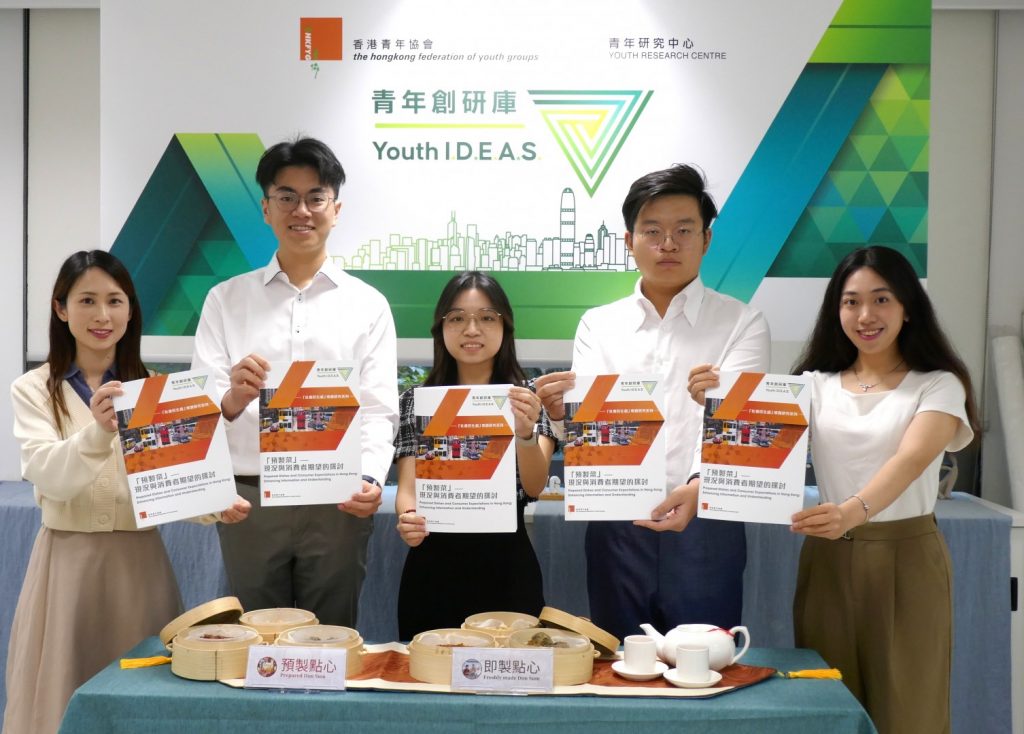
Youth IDEAS released “Prepared Dishes and Consumer Expectations in Hong Kong: Enhancing Information and Understanding”
English Summary
- Youth I.D.E.A.S., the youth think tank under the Youth Research Centre of The Hong Kong Federation of Youth Groups (HKFYG), today (20 March) released a research report titled “Prepared Dishes and Consumer Expectations in Hong Kong: Enhancing Information and Understanding”
- The report is based on a survey of 800 local residents aged 18 to 64, along with interviews with 13 individuals and 7 experts, scholars and industry practitioners, conducted between December 2025 and February 2026
Key findings:
- 3% find it difficult to accurately identify pre-made dishes in restaurants; cooked-to-order dishes remain the prevailing expectation for 64.0%
- 3% hold a neutral impression of prepared dishes; lack of flavour or “wok hei” (26.4%), excessive additives (25.4%) and poor texture (22.9%) are among their primary concerns
Confidence and Disclosure
- 5% would lose confidence if restaurants fail to disclose the use of prepared dishes; 49.0% would still visit restaurants if the use of prepared dishes is clearly disclosed
- In addition to information transparency, taste and price are also among consumers’ priorities
- Moreover, 83.3% believe restaurants should indicate the use of “fully prepared” dishes
- Interviewees expect to be informed about “fully prepared” dishes that are only reheated before serving; they would feel deceived if charged cooked-to-order prices for prepared dishes
Concerns and Priorities
- When dining out, 62.4% would prioritise “taste,” followed by “price” (51.9%), hygiene (32.6%) and food safety (27.6%)
- 9% think that prepared dishes should be priced lower than cooked-to-order ones
- Interviewees express concerns about the freshness of prepared dishes and the use of preservatives
Industry Perspectives
- F&B professionals state that prepared dishes are a practical response to labour shortages, the lack of experienced chefs and high operational costs
- Experts and scholars reassure that the existing food technologies can effectively preserve nutrients and ensure hygiene, while food safety is already regulated by law
- While the city now lacks a clear definition and scope of prepared dishes, mandatory labelling would be difficult to enforce, according to experts and scholars
Recommendations:
- Vivian Lai Chui-yan, Deputy Convenor of Society and Livelihood Group of the think tank, notes that integrity is central to Hong Kong’s standing as a Culinary Capital and calls for the safeguarding of consumers’ right to be informed
- Member of the Group Kady Wong Ka-hing recommends commissioning an independent study to develop an official Voluntary Certification Scheme, building an official certification mark and fostering consumer trust in the dining scene
- Group Member Jerry Ching Chi-fung recommends formulating practical guidelines under the Trade Descriptions Ordinance to pinpoint non-compliance scenarios, safeguarding consumers’ right to make informed decisions
- Group Member Tommy Siu Ching-yuen recommends enhancing consumer understanding through public education, with government-produced materials and community-based programmes in place
- Siu adds that this dual-track approach would help the public gain a scientific perspective on food production, sustaining Hong Kong’s reputation as a Culinary Capital in the long run
About Youth I.D.E.A.S.
Youth I.D.E.A.S. (Ideals, Dedication, Engagement, Aspirations and Service) is a local youth think tank established by the Youth Research Centre of the HKFYG. The new term (2025-2027) brings together nearly 80 young professionals and tertiary students, with an average age of 27. Through evidence-based research, members aim to inspire social change through policy advocacy across three areas: Employment and the Economy, Society and Livelihood, and Youth Development and Engagement. The youth think tank is advised by six experts and academics, namely, Dr Louis Cheung Chi Yan, Mr Joe Ngai, Prof Anthony Cheung Bing-leung, Mr Paul Chan Chi-yuen, Prof Anthony Fung Ying-him and Dr Fan Ning.